
How to choose local citrus at a market stall
The first rule at Jeruk Indonesia: do not choose local Indonesian citrus by peel colour. Peel colour has almost no relationship with the quality inside, and the keprok mandarin standard measures ripeness by juice and sweetness, not colour. What you can check at the stall: defects that go through to the flesh, unusually wet peel, and the taste of one fruit cut open.
Checklist
- Ignore colour. A green peel can be ripe, and an even orange peel can come from a postharvest treatment. Details are in guide to green-skinned but sweet citrus.
- Tell peel defects from flesh defects. The draft revision of SNI 3165 still accepts peel defects up to 15% of the surface in class B, as long as they do not affect the flesh. Spots on the peel alone are no reason to reject fruit for juicing.
- Reject fruit damaged by extreme temperatures or unusually wet. Condensation right after leaving a cold room is normal.
- Ask to cut one fruit open. Ripeness is measured from the inside: plenty of juice and sweetness. Your eyes and tongue are the closest measuring tools available at the stall.
- Do not equate size with taste. Size codes and traders' grades only sort fruit by how big it is.
If you are buying for juice
The draft revision of SNI 3165 uses a minimum juice content of 33% of fruit weight as a ripeness requirement for keprok mandarins. That is a lower limit, not an average. For a business, the surer way is to squeeze sample fruit from the seller and calculate it in the juice calculator.
What we deliberately leave out
- Tips such as weighing in the hand, pressing the peel, tapping, or looking at the pores. We found no official source that tested them, so we do not recommend them.
- Promises that a certain trait makes citrus sweet. Taste depends on variety, season, and orchard.
Turn and check
Turn the fruit. Each quarter turn ticks one point about the peel: the sourced ones, and one tip we do not recommend.
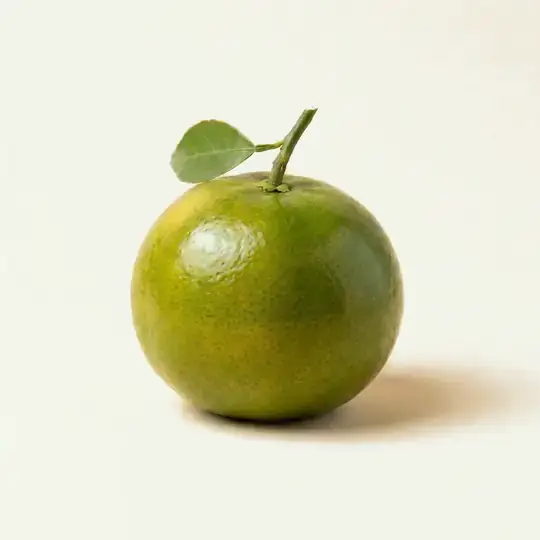
- A green peel can be ripe. Peel colour is not a measure of ripeness.
- Spots on the peel alone are no reason to reject fruit for juicing.
- We found no institutional test of checking pores or pressing the peel, so we do not recommend it.
- Ripeness is measured from the inside. Ask the seller to cut one fruit open.
Measure citrus at the stall and get its code
Measure the width of the fruit with a ruler or calipers, then move Diameter to that number. The size code comes from the size code table in the draft revision of the keprok mandarin standard.
Match the screen to a bank card
Want the circle on screen to match the real fruit? Hold a bank card against the screen and move Card width until the green box matches your card exactly. On narrow screens the box stands upright, so hold the card upright too.
The circle is not to scale yet: set the card width first. Until then, the circle only compares the codes with each other.
Code 3: over 60 to 70 mm
- Code 1over 80 mm
- Code 2over 70 to 80 mm
- Code 3over 60 to 70 mm
- Code 4over 50 to 60 mm
- Code 5over 40 to 50 mm
- Code 6over 30 to 40 mm
Compare two varieties before you buy
Pick two varieties. Move the divider to reveal one fruit over the other. Only traits written in the source documents are shown.
Traits of two varieties from their fact cards
| Trait | Siam Pontianak | Keprok Batu 55 |
|---|---|---|
| Taste | sweet | sweet, slightly tart, fresh |
| Size | round, medium size | round, medium size |
| Peel | thin, smooth and glossy, yellowish green to yellow | yellow-orange |
| Origin | Tebas District, Sambas Regency | Batu, East Java |
After buying: how long it keeps
Tap a row. All bars share the same day scale, and the box below explains where each figure comes from. These are test results or variety document records, not a promise for the fruit in your kitchen.
A Universitas Syiah Kuala study on siam mandarins: 15 days at 10 °C, 14 days at 15 °C, and 13 days at 28 °C.
Where each row's figure comes from:
Siam, 10 °C. A Universitas Syiah Kuala study on siam mandarins: 15 days at 10 °C, 14 days at 15 °C, and 13 days at 28 °C.
Siam, 28 °C (room temperature). At tropical room temperature, siam fruit in the same study lasted 13 days. That is only two days less than at 10 °C.
Mandarin, 5 to 8 °C. USDA Handbook 66: mandarins are stored at 5 to 8 °C and 95% humidity for up to 4 weeks. Chilling injury can occur below 5 °C.
Keprok SoE86 Agrihorti, 28 °C. Storage life written in its variety description document: 4 weeks at 28 °C.
Purut Puri Agrihorti, 20 °C. Storage life written in its variety description document: 2 to 8 weeks at 20 °C.
Lemon Cai Kahuripan, 24 to 27 °C. Storage life written in its variety description document: 30 to 45 days at 24 to 27 °C.
Pamelo Pamindo Agrihorti, 28 °C. Storage life written in its variety description document: 6 to 8 weeks at 28 °C.
Sources
- Ritenour and Alferez, University of Florida IFAS (published in Citrus Industry) 05 Quality note
- Badan Standardisasi Nasional (RSNI3 3165:2024 Jeruk keprok, draft revision of SNI 3165:2009) 06 Quality note
- Universitas Tanjungpura (Lakon et al., 'Optimalisasi Olahan Jeruk Siam Pontianak di Kabupaten Sambas') 01 Quality note
Other sources on this page
- Badan Litbang Pertanian, Kementerian Pertanian (book 'Jeruk Nusantara dan Sebaran Benih Sumber', 2020) 02 Quality note
- Jurnal Ilmiah Mahasiswa Pertanian Universitas Syiah Kuala, Vol. 1 No. 1 (2016), pp. 1077-1086 (Wahyuningsih, Ratna, Zulfahrizal; DOI 10.17969/jimfp.v1i1.1166) 10 Quality note
- USDA Agricultural Research Service, Agriculture Handbook 66 (2016 revision), chapter Mandarin (Tangerine) by J.K. Burns, p. 405 11 Quality note
- Direktorat Jenderal Hortikultura, Kementerian Pertanian (seed database, variety description document for Keprok SoE86 Agrihorti; applicant: Balitjestro) 12 Quality note
- Direktorat Jenderal Hortikultura, Kementerian Pertanian (seed database, variety description document for Jeruk Purut Puri Agrihorti; applicant: Balitjestro) 03 Quality note
- Direktorat Jenderal Hortikultura, Kementerian Pertanian (seed database, variety description document for Lemon Cai Kahuripan; applicant: Dinas Tanaman Pangan dan Hortikultura) 07 Quality note
- Direktorat Jenderal Hortikultura, Kementerian Pertanian (seed database, variety description document for Pamelo Pamindo Agrihorti; applicant: Balitjestro) 08 Quality note
- Information about Jerpon HR comes from the site's operator.
Quality notes for each source are on the page Sources.