
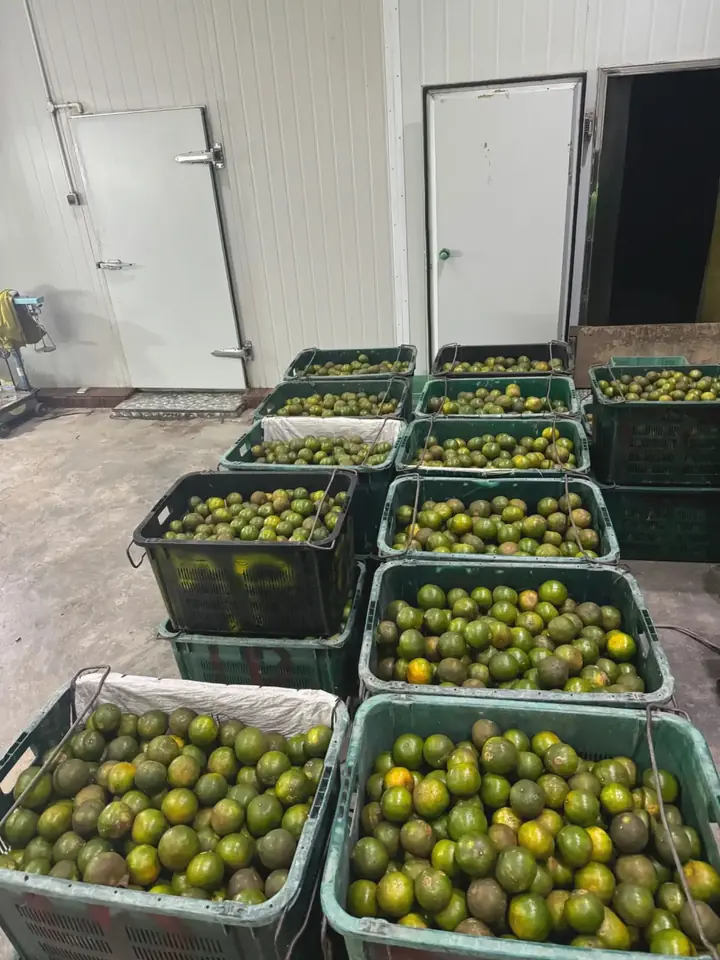
Why are Indonesian oranges green but sweet?
Citrus peel changes from green to orange when night temperatures drop below about 13 °C. Where nights never get that cold, the fruit stays green even when the inside is ripe. According to University of Florida researchers, peel colour has almost no relationship with the ripeness or internal quality of the fruit. That is why Jeruk Indonesia does not treat peel colour as a sign of ripeness.
- Flesh already orange and ripe; its colour does not follow the peel colour.
- White layer separates the peel from the flesh.
- Peel stays green as long as its chlorophyll remains. That happens when nights stay warm.
Tap a layer to read its explanation here.
Illustration, not a photo.Night temperature sets peel colour
University of Florida researchers write that citrus peel colour change is triggered by night temperatures below 55 °F, about 13 °C. The USDA postharvest handbook notes the same for mandarins: in areas where temperatures stay high, natural colour change in the peel does not happen.
That is why citrus from orchards with warm nights can reach the market with green or yellowish-green peel even when the inside is ripe.
Green does not mean unripe
The draft revision of SNI 3165 for keprok mandarins does not use peel colour as a ripeness measure. It measures the inside of the fruit: at least 33% juice, at least 10 °Brix dissolved solids, and a dissolved solids to acid ratio of at least 12:1.
Variety documents from Kementerian Pertanian (Ministry of Agriculture) give examples. Lemon Cai Kahuripan is recorded with a green peel when ripe, and the Pamindo Agrihorti pomelo with a yellowish-green peel when ripe.
Colour is not ignored in every market. The USDA handbook, written for trade in the United States, records a mandarin maturity standard that requires a minimum dissolved solids to acid ratio and at least 50% of the peel surface to have started changing colour.
Why some citrus is evenly orange
There is a postharvest treatment called degreening. In Florida, fruit is exposed to low levels of ethylene gas, about 3 to 5 ppm, at 82 to 85 °F. According to the researchers, this treatment does not meaningfully change the internal quality of the fruit.
The draft revision of SNI 3165 allows degreening and waxing of keprok mandarins as long as food safety requirements are met. So an even orange colour can come from a cool growing climate or from this treatment. Colour alone cannot tell the two apart.
Orange fruit can turn green again
Fruit that has coloured can turn green again if it is not harvested before nights warm up again. Researchers call this regreening.
What we do not know yet
- How widely degreening is used on citrus sold in Indonesia. We found no figure from an official source.
- Night temperatures in each Indonesian citrus growing centre. This page has no weather data by region.
The peel changes, the fruit inside does not
Slide from a tropical orchard to after the peel's chlorophyll is removed. Only the peel colour changes. The flesh was orange from the start.
Green peel and orange peel, side by side
Pick two varieties. Move the divider to reveal one fruit over the other. Only traits written in the source documents are shown.
Traits of two varieties from their fact cards
| Trait | Siam Pontianak | Keprok Batu 55 |
|---|---|---|
| Taste | sweet | sweet, slightly tart, fresh |
| Size | round, medium size | round, medium size |
| Peel | thin, smooth and glossy, yellowish green to yellow | yellow-orange |
| Origin | Tebas District, Sambas Regency | Batu, East Java |
Storage life according to references
Tap a row. All bars share the same day scale, and the box below explains where each figure comes from. These are test results or variety document records, not a promise for the fruit in your kitchen.
A Universitas Syiah Kuala study on siam mandarins: 15 days at 10 °C, 14 days at 15 °C, and 13 days at 28 °C.
Where each row's figure comes from:
Siam, 10 °C. A Universitas Syiah Kuala study on siam mandarins: 15 days at 10 °C, 14 days at 15 °C, and 13 days at 28 °C.
Siam, 28 °C (room temperature). At tropical room temperature, siam fruit in the same study lasted 13 days. That is only two days less than at 10 °C.
Mandarin, 5 to 8 °C. USDA Handbook 66: mandarins are stored at 5 to 8 °C and 95% humidity for up to 4 weeks. Chilling injury can occur below 5 °C.
Keprok SoE86 Agrihorti, 28 °C. Storage life written in its variety description document: 4 weeks at 28 °C.
Purut Puri Agrihorti, 20 °C. Storage life written in its variety description document: 2 to 8 weeks at 20 °C.
Lemon Cai Kahuripan, 24 to 27 °C. Storage life written in its variety description document: 30 to 45 days at 24 to 27 °C.
Pamelo Pamindo Agrihorti, 28 °C. Storage life written in its variety description document: 6 to 8 weeks at 28 °C.
Sources
- Ritenour and Alferez, University of Florida IFAS (published in Citrus Industry) 05 Quality note
- USDA Agricultural Research Service, Agriculture Handbook 66 (2016 revision), chapter Mandarin (Tangerine) by J.K. Burns, p. 405 11 Quality note
- Badan Standardisasi Nasional (RSNI3 3165:2024 Jeruk keprok, draft revision of SNI 3165:2009) 06 Quality note
Other sources on this page
- Direktorat Jenderal Hortikultura, Kementerian Pertanian (seed database, variety description document for Lemon Cai Kahuripan; applicant: Dinas Tanaman Pangan dan Hortikultura) 07 Quality note
- Direktorat Jenderal Hortikultura, Kementerian Pertanian (seed database, variety description document for Pamelo Pamindo Agrihorti; applicant: Balitjestro) 08 Quality note
- Universitas Tanjungpura (Lakon et al., 'Optimalisasi Olahan Jeruk Siam Pontianak di Kabupaten Sambas') 01 Quality note
- Badan Litbang Pertanian, Kementerian Pertanian (book 'Jeruk Nusantara dan Sebaran Benih Sumber', 2020) 02 Quality note
- Jurnal Ilmiah Mahasiswa Pertanian Universitas Syiah Kuala, Vol. 1 No. 1 (2016), pp. 1077-1086 (Wahyuningsih, Ratna, Zulfahrizal; DOI 10.17969/jimfp.v1i1.1166) 10 Quality note
- Direktorat Jenderal Hortikultura, Kementerian Pertanian (seed database, variety description document for Keprok SoE86 Agrihorti; applicant: Balitjestro) 12 Quality note
- Direktorat Jenderal Hortikultura, Kementerian Pertanian (seed database, variety description document for Jeruk Purut Puri Agrihorti; applicant: Balitjestro) 03 Quality note
- Information about Jerpon HR comes from the site's operator.
Quality notes for each source are on the page Sources.